The calm herb with a liver problem
The pooled trials report one of the largest effects on stress we have seen anywhere. They also disagree with each other so violently that the pooling barely means anything, and regulators have started counting hospital admissions.
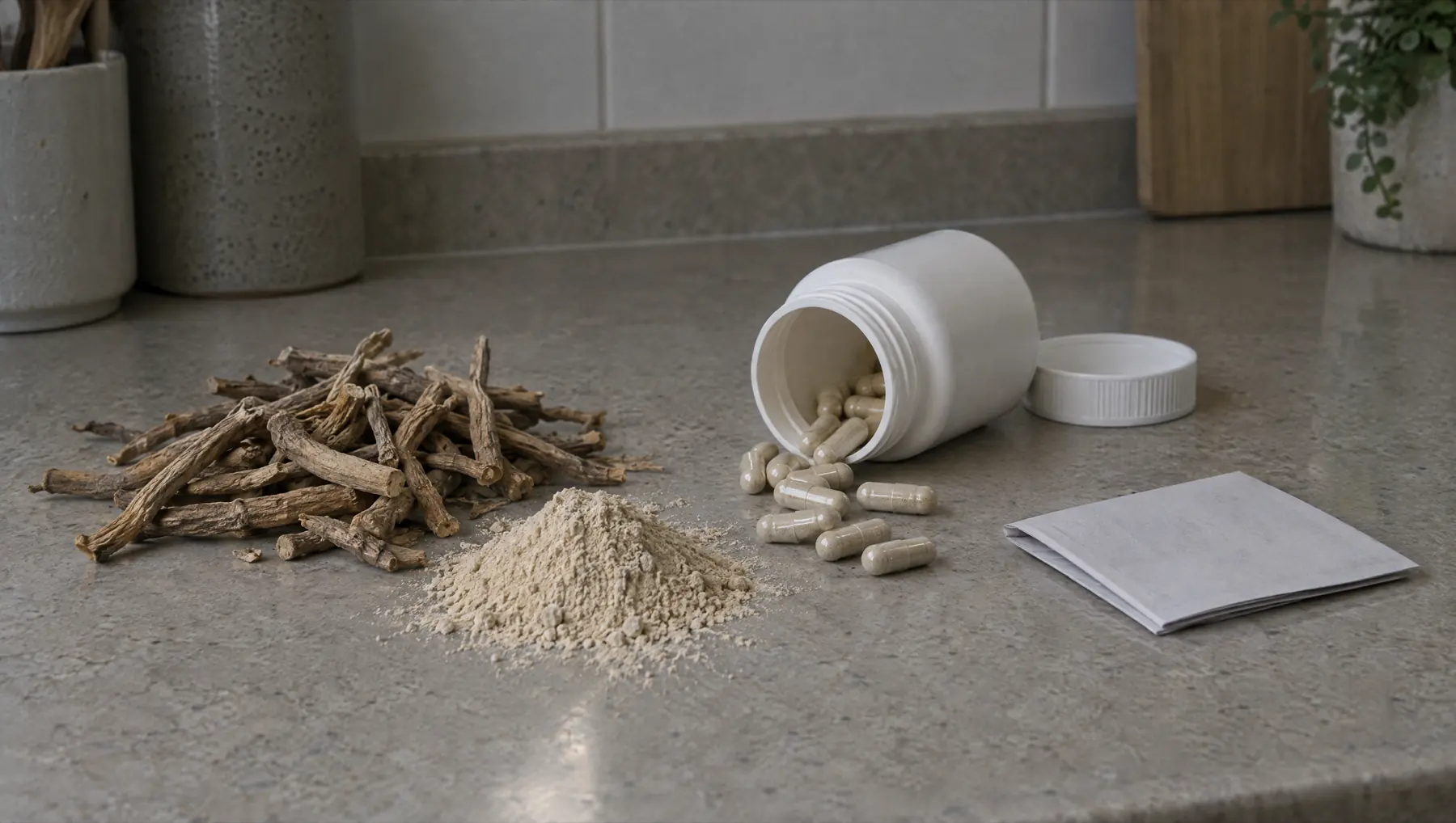
Ashwagandha is the best-selling calming supplement in the western world, and it is the clearest case on this site of a big number that does not mean what it looks like it means.
The number people quote
A 2022 meta-analysis in Phytotherapy Research pooled twelve papers and 1002 participants. It reported:
- Anxiety reduced by a standardised mean difference of -1.55 (95% CI -2.37 to -0.74).
- Stress reduced by -1.75 (95% CI -2.29 to -1.22).
In this kind of measure, 0.2 is a small effect, 0.5 is moderate and 0.8 is large. Values above 1.5 are the sort of thing you see when a drug works spectacularly, and they are rare. If that were the whole story, ashwagandha would be one of the most effective things in this journal.
The number underneath it
The same paper reports its heterogeneity. For anxiety it was 93.8%. For stress it was 83.1%.
Heterogeneity is how much the individual trials disagree with each other. Under about 40% you can reasonably treat the studies as measuring one thing. Above 75% you cannot. At 93.8% the trials are not converging on an answer, and averaging them produces a number with a confidence interval attached and very little meaning behind it.
Reviewers of this literature have been blunt about why. The trials are small, several have dropout rates above 20%, and in some of them the authors were employees of the company that made the supplement being tested. The most common summary is that the trials are underpowered and methodologically flawed, and that the evidence is not sufficient to settle the question.
The part that is not about efficacy
In February 2024 the Australian Therapeutic Goods Administration published a safety alert. It had received twelve reports of liver problems in people taking products containing Withania somnifera. Seven of those carried enough detail to suggest the liver injury may have been caused by it. In four, no other ingredient was a likely cause. Four cases required hospital admission.
Most people recovered once they stopped taking it. The regulator described the risk as very rare, and that phrasing matters: this is not a common harm, and millions of doses are taken without incident. But it is a real signal, it is recorded, and it is almost never mentioned by anybody selling the product.
What we do with this
We do not stock it, and this is the piece explaining why rather than a check on something in the shop.
The honest position is not that ashwagandha does nothing. It is that the trials are too small and too inconsistent to tell us what it does, that the largest reported effects come from the least reliable studies, and that the one thing the literature has established with reasonable confidence is a rare liver risk. That is an unusual shape for a supplement: better evidence for the harm than for the benefit.
If you take it and you have any liver condition, or you develop yellowing of the skin or eyes, dark urine, unusual tiredness or pain in the upper abdomen, the regulator's advice is to stop and see a doctor. That is not our advice. We are not qualified to give any. It is theirs, and it is linked below.